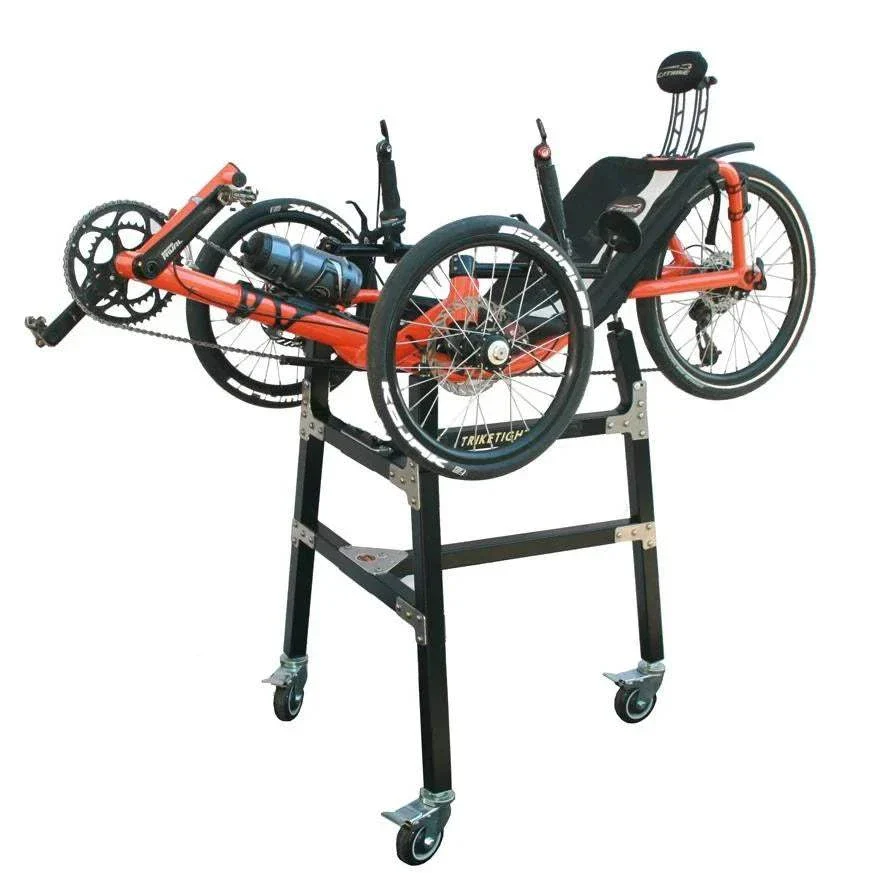
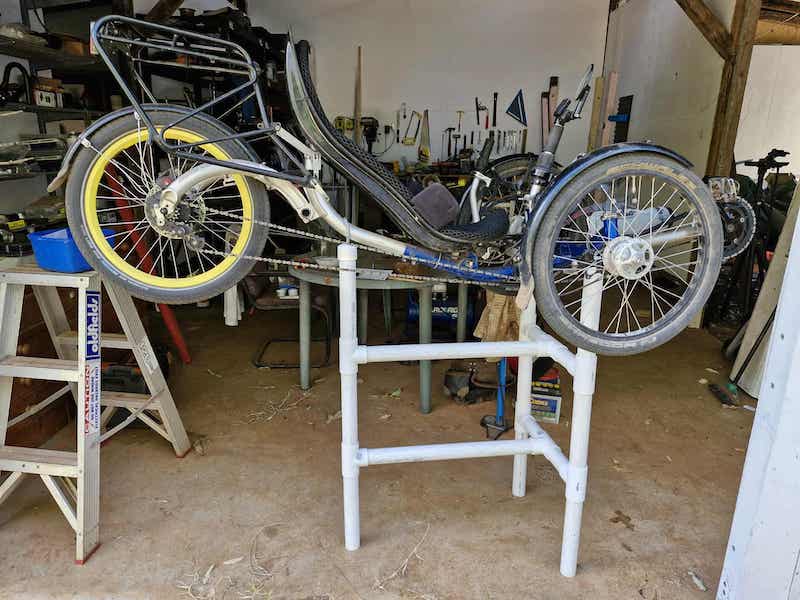
You can buy a commercially available stand like this
OR
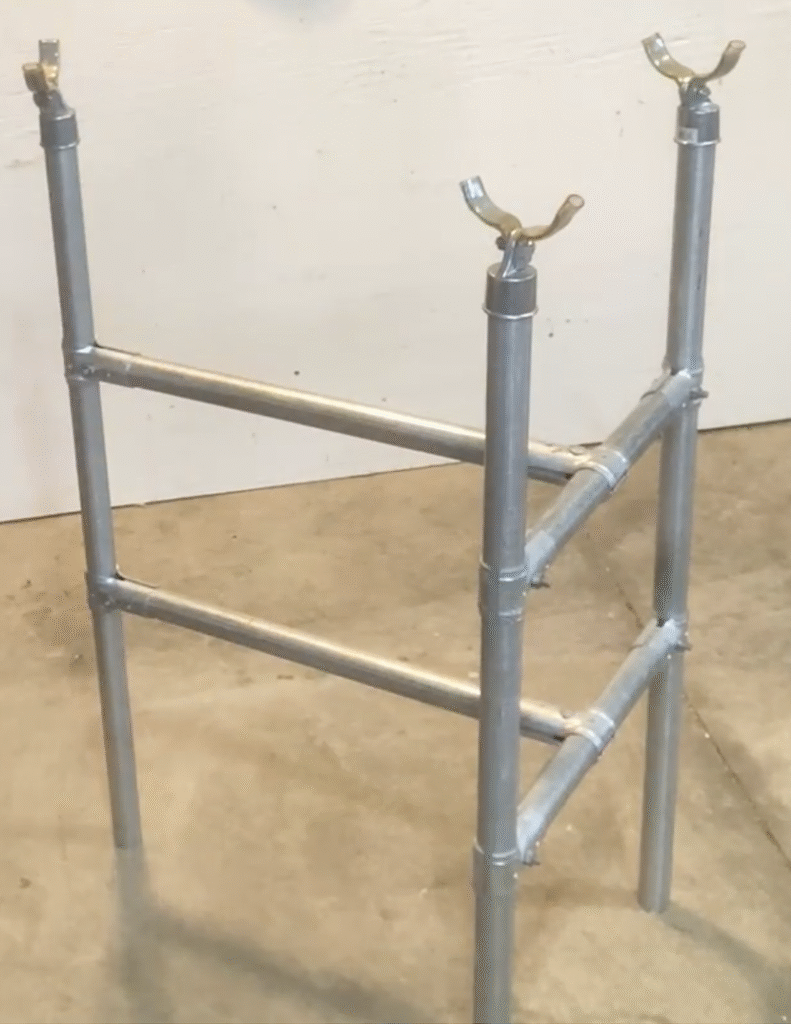
build your own like this:
This video shows how to build a trike stand to get the trike up off of the ground and make it easier to work on. He uses 1 3/4″ (45mm) galvanised steel fence tubing but you can build it using PVC pressure pipe instead.
Lockable castors will help move it around your shed.
Build a trolly to get your recumbent tadpole trike into your apartment or a tight place. Most trikes will not fit through a standard door opening. This trolly allows you to hold the trike on its side and get it through a door opening and move it around easier.
The majority of tail fairings and tailboxes on recumbents are either full composite fibreglass or carbon fibre, or they are home made in Corflute (Coreplast) which is a plastic sheet material used by signwriters.
The composite units are expensive and a large investment in time for a homebuilder. The coreflute ones, well, put bluntly they look a bit scrappy, and it’s hard to mould coreflute into complex curves – not that it can’t be done, of course!
I saw how effective the best fairings at the Greenspeed Challenge appeared to be (admittedly the bikes in question were being ridden by fairly athletic types), and decided to have a try myself.
This fairing is made using a combination of current composite technology and old fabric aircraft techniques.
To get the profile right for the rider so that the air flows a smoothly as possible, the first step in the whole process was to tape a large cardboard sheet up behind the seat, sit in it, and trace around the body onto the sheet.
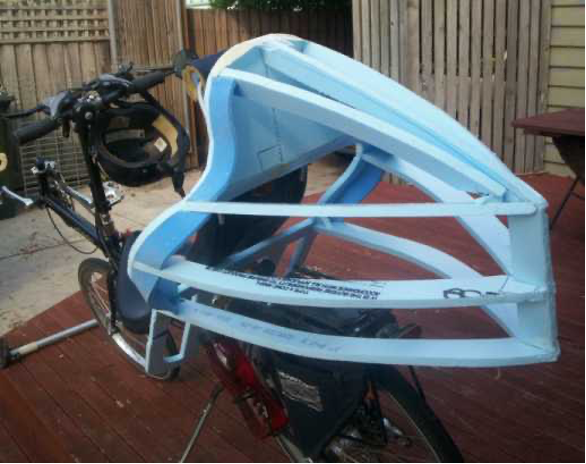
This is then reproduced in 13mm blue Dow styrofoam and becomes the base onto which everything else is attached.
The internal frame of the fairing is made of thin ribs of the blue styrofoam cut using a “stanley” knife. This is higher density than the white stuff and can be sculpted and sanded.
The ribs are tacked together onto the seat-backing using 5 minute epoxy (like Araldite) Each rib is traced as a mirror image to get the whole thing symetrical.
The completed frame is reinforced with 50mm wide fibreglass tape wetted with epoxy resin (proper stuff for fibreglass work).
This provides rigidity as well as providing a barrier so that other glues and paints won’t disolve the stryrofoam. You can’t use polyester resin – it will melt the foam.
The frame is then covered with Stitts PolyFibre (or Ceconite) and glued on using PolyBrush.
These are an unshrunken polyester with a relatively open weave compared with your business shirt!
A hot air gun is used to then shrink the fabric to drum-tight.
The open weave of the fabric is then filled by brushing on more PolyBrush.
Once dry, it was painted, then a sealing strip of light “expansion joint” foam was glued around the edge to provide a good seal to the rider’s body. A simple contact glue was used for this.
The fairing was designed to slip over the bike’s rack and lock into place. There’s a luggage compartment behind the rider.
The whole thing weighs only 1.2 kilograms!
Performance: 1) On two major rides on windy days against other bikes.
First impressions were that against the wind and on the flat at speed I definitely don’t have to work so hard. When riding with others down hills, I tended to draw ahead (I could coast while they had to pedal at times to maintain speed against the wind).
2)Controlled test on a slope. On a calm day I did several roll-downs on a slope near home with a bike computer attached (and calibrated against a GPS).
The terminal velocity on this slope is about 30km/hr on this bike (ie: you accelerate to about 30km/hr, but no further thanks to wind resistance).
In multiple tests, the bike with fairing was always 1.5 to 2km/hr faster when it reached terminal velocity.
It’s not a big difference, but if you consider that the effects of drag acrue as the SQUARE of air speed, it can make a big difference to the required effort if you’re bucking a major headwind!!!!
Being so light it has no effect on my climb capability, such as it is.
Note: it’s also very quiet, with no road noise resonance because of the flexible fabric structure.
After fun 25 years of bike building, Atomic Zombie is going to retire, so he has made up this “Master Collection” that contains everything he has ever built.
This special will remain up until he transitions into a new phase of life. For more information on all 40 DIY Plans, you can see a details page on ChopZone.com.
Thanks to all those who have put a grinder to a bike frame!